The Tabernacle after the Pattern

The Tabernacle of God in the Wilderness of Sin
…He clothed His divinity with humanity, and came into the world, in order that His humanity might touch humanity and His divinity lay hold upon the throne of God in man's behalf. He came to seek the one lost sheep, to bring back the wandering one from the wilderness of sin to the heavenly fold.…—SW:25.2
…the tabernacle built by Moses was made after a pattern. The Lord directed him: "According to all that I show thee, after the pattern of the tabernacle, and the pattern of all the instruments thereof, even so shall ye make it." And again the charge was given, "Look that thou make them after their pattern, which was showed thee in the mount." Exodus 25:9, 40. And Paul says that the first tabernacle "was a figure for the time then present, in which were offered both gifts and sacrifices;" that its holy places were "patterns of things in the heavens;" that the priests who offered gifts according to the law served "unto the example and shadow of heavenly things," and that "Christ is not entered into the holy places made with hands, which are the figures of the true; but into heaven itself, now to appear in the presence of God for us." Hebrews 9:9, 23; 8:5; 9:24. 414 {GC 413.3} The sanctuary in heaven, in which Jesus ministers in our behalf, is the great original, of which the sanctuary built by Moses was a copy. God placed His Spirit upon the builders of the earthly sanctuary. The artistic skill displayed in its construction was a manifestation of divine wisdom. The walls had the appearance of massive gold, reflecting in every direction the light of the seven lamps of the golden candlestick. The table of shewbread and the altar of incense glittered like burnished gold. The gorgeous curtain which formed the ceiling, inwrought with figures of angels in blue and purple and scarlet, added to the beauty of the scene. And beyond the second veil was the holy Shekinah, the visible manifestation of God's glory, before which none but the high priest could enter and live.—GC:413.3-414.1
Pr. 25:2—It is the glory of God to conceal a thing: but the honour of kings is to search out a matter.
Donated materials, dimensions of the tabernacle in the wilderness
"...The holy places made with hands were to be 'figures of the true,' 'patterns of things in the heavens' (Hebrews 9:24, 23)—a miniature representation of the heavenly temple where Christ, our great High Priest, after offering His life as a sacrifice, was to minister in the sinner’s behalf. God presented before Moses in the mount a view of the heavenly sanctuary, and commanded him to make all things according to the pattern shown him. All these directions were carefully recorded by Moses, who communicated them to the leaders of the people.
"For the building of the sanctuary great and expensive preparations were necessary; a large amount of the most precious and costly material was required; yet the Lord accepted only freewill offerings. “Of every man that giveth it willingly with his heart ye shall take My offering” was the divine command repeated by Moses to the congregation. Devotion to God and a spirit of sacrifice were the first requisites in preparing a dwelling place for the Most High."—PP:343.2, 3
Supported by
"Free will offerings"
Raw materials used:
Primary Materials. Ex. 25:3-7
bracelets, earrings, rings, tablets, all jewels of gold, badgers' skins, blue, purple, scarlet, fine linen, goats’ hair, rams’ skins dyed red, sealskins, offering of silver, brass, acacia wood,
"...The wood employed for the building and its furniture was that of the acacia tree, which was less subject to decay than any other to be obtained at Sinai...."—PP:347.1
onyx stones, the (other) stones, spice, oil [for the light, and for the anointing oil, and for the sweet incense].
The Breastplate of Judgment. Ex. 28:17-20
Setting of Stones in 4 rows of stones:
1st row: a sardius, a topaz, a carbuncle.
2nd row: an emerald, a sapphire, a diamond.
3rd row: a ligure, an agate, an amethyst.
4th row: a beryl, an onyx, a jasper
Holy Anointing Oil Materials. Ex. 30:23-25
Principal Spices: myrrh, cinnamon, sweet calamus, cassia, and olive oil is the carrier.
Holy Incense Materials. Ex. 30:34, 35
Sweet Spices: stacte (or nataf in Hebrew), onycha, galbanum, pure frankincense.
Ten Curtains. Ex. 26:1
Fine twined linen: and blue, and purple, and scarlet: with cherubims of cunning work.
"Dimensions of the Tabernacle"
"...not more than fifty-five feet in length,..."—PP:347.1
54 ft. in length (we will see how we came to this figure in a moment)
18 ft. in-depth and height
"...and eighteen in breadth and height."—PP:347.1
The Bible gives for these three measurements:
30 cu. in length
10 cu. in depth
10 cu. in height
[According to Ron Wyatt from http://wyattmuseum.com and Wikipedia: 1 Royal Egyptian cubit is 20.6 inches???]
https://en.m.wikipedia.org/wiki/Cubit#Ancient_Egyptian_royal_cubit
Let's calculate the breadth and the height.
Take the revealed exact measurement of 18 ft. By the Spirit of Prophecy for the height of the sanctuary and divide that by 10 cubits, the revealed height of measurement given in the Bible, and you get
"1.8" feet
Convert 1.8 feet to inches =
"21.6" Inches or 21 19/32"
Multiply a cubit in inches "21.6" by the known height of the sanctuary of 10 cubits and that brings you to "216" inches.
216" / 12" = 18' exact
Now
Take the approximate revealed limitation of no more than 55' (exact measurement is 54 ft.) for the length of the sanctuary and divide that by 30 cubits, the revealed length of measurement given in the Bible and you get
"1.8" feet
This number turns into 21.6 in. in an online converter.
Convert 1.8 feet to inches =
"21.6" Inches or 21 19/32"
To get the fraction 19/32"
Multiply a cubit in inches "21.6" by the known length of the sanctuary of 30 cubits and that brings you to "648" inches.
648" / 12" = 54' exact.
"Boards for the Tabernacle"
Ex. 26:15-29—"And thou shalt make boards for the tabernacle of shittim wood standing up.
[16] Ten cubits shall be the length of a board, and a cubit and a half shall be the breadth of one board.
"Ten cubits…the length"
21.6" x 10 cu. = 216"
216" / 12" = 18 ft. long
"...a cubit and a half…the breadth…"
21.6" x 1.5 cu. = 32.4"
32.4" / 12" = 2.7' ft. or 2' 8 13/32" depth
[17] Two tenons shall there be in one board, set in order one against another: thus shalt thou make for all the boards of the tabernacle.
South
[18] And thou shalt make the boards for the tabernacle, twenty boards on the south side southward.
[19] And thou shalt make forty sockets of silver under the twenty boards; two sockets under one board for his two tenons, and two sockets under another board for his two tenons.
North
[20] And for the second side of the tabernacle on the north side there shall be twenty boards:
[21] And their forty sockets of silver; two sockets under one board, and two sockets under another board.
West
[22] And for the sides of the tabernacle westward thou shalt make six boards.
[23] And two boards shalt thou make for the corners of the tabernacle in the two sides.
[24] And they shall be coupled together beneath, and they shall be coupled together above the head of it unto one ring: thus shall it be for them both; they shall be for the two corners.
[25] And they shall be eight boards, and their sockets of silver, sixteen sockets; two sockets under one board, and two sockets under another board.
"Bars"
[26] And thou shalt make bars of shittim wood; five for the boards of the one side of the tabernacle,
[27] And five bars for the boards of the other side of the tabernacle, and five bars for the boards of the side of the tabernacle, for the two sides westward.
[28] And the middle bar in the midst of the boards shall reach from end to end.
[29] And thou shalt overlay the boards with gold, and make their rings of gold for places for the bars: and thou shalt overlay the bars with gold.
"A Vail"
Ex. 26:31-33—"And thou shalt make a vail of blue, and purple, and scarlet, and fine twined linen of cunning work: with cherubims shall it be made:
[32] And thou shalt hang it upon four pillars of shittim wood overlaid with gold: their hooks shall be of gold, upon the four sockets of silver.
[33] And thou shalt hang up the vail under the taches, that thou mayest bring in thither within the vail the ark of the testimony: and the vail shall divide unto you between the holy place and the most holy."
“The building was divided into two apartments by a rich and beautiful curtain, or veil, suspended from gold-plated pillars; and a similar veil closed the entrance of the first apartment. These, like the inner covering, which formed the ceiling, were of the most gorgeous colors, blue, purple, and scarlet, beautifully arranged, while inwrought with threads of gold and silver were cherubim to represent the angelic host who are connected with the work of the heavenly sanctuary and who are ministering spirits to the people of God on earth.”—PP:347.2
"The Door"
Ex. 26:36, 37—"And thou shalt make an hanging for the door of the tent, of blue, and purple, and scarlet, and fine twined linen, wrought with needlework.
[37] And thou shalt make for the hanging five pillars of shittim wood, and overlay them with gold, and their hooks shall be of gold: and thou shalt cast five sockets of brass for them.


The furniture
"The Ark of the Testament"
Ex. 25:10—"And they shall make an ark of shittim wood: two cubits and a half shall be the length thereof, and a cubit and a half the breadth thereof, and a cubit and a half the height thereof."
A cubit "21.6" inches
.5 x 21.6" = 10.8"
"...two cubits and a half shall be the length..."
21.6" x 2.5 cu. = 54"
54" / 12" = 4.5 ft. or 4' 6" long
"...a cubit and a half the breadth..."
21.6" x 1.5 cu. = 32.4"
32.4" / 12" = 2.7' ft. or 2' 8 13/32" depth
"...a cubit and a half the height..."
21.6" x 1.5 cu = 32.4"
32.4" / 12" = 2.7' ft. or 2' 8 13/32" height
"The Mercy Seat"
Ex. 25:17—"And thou shalt make a mercy seat of pure gold: two cubits and a half shall be the length thereof, and a cubit and a half the breadth thereof."
"...two cubits and a half shall be the length..."
21.6" x 2.5 cu = 54"
54" / 12" = 4.5 ft. or 4' 6" long
"...a cubit and a half the breadth..."
21.6" x 1.5 cu = 32.4"
32.4" / 12" = 2.7' ft. or 2' 8 13/32" depth
Ex. 25:18-22—"And thou shalt make two cherubims of gold, of beaten work shalt thou make them, in the two ends of the mercy seat.
[19] And make one cherub on the one end, and the other cherub on the other end: even of the mercy seat shall ye make the cherubims on the two ends thereof.
[20] And the cherubims shall stretch forth their wings on high, covering the mercy seat with their wings, and their faces shall look one to another; toward the mercy seat shall the faces of the cherubims be.
[21] And thou shalt put the mercy seat above upon the ark; and in the ark thou shalt put the testimony that I shall give thee.
[22] And there I will meet with thee, and I will commune with thee from above the mercy seat, from between the two cherubims which are upon the ark of the testimony, of all things which I will give thee in commandment unto the children of Israel.
"The cover of the sacred chest was called the mercy seat. This was wrought of one solid piece of gold, and was surmounted by golden cherubim, one standing on each end. One wing of each angel was stretched forth on high, while the other was folded over the body (see Ezekiel 1:11) in token of reverence and humility."—PP:348.3
No measurements are given for these cherubim connected to the mercy seat. However, the Bible lets us know what a cherub looks like.
Eze. 1:8—"And they had the hands of a man under their wings on their four sides; and they four had their faces and their wings."
Eze. 10:2—"And he spake unto the man clothed with linen, and said, Go in between the wheels, even under the cherub, and fill thine hand with coals of fire from between the cherubims, and scatter them over the city. And he went in in my sight."
Now here is the rub. I have an issue about how the cherubim in Ezekiel are described and why in the SOP she said "The cover of the sacred chest was called the mercy seat. This was wrought of one solid piece of gold, and was surmounted by golden cherubim, one standing on each end. One wing of each angel was stretched forth on high, while the other was folded over the body (see Ezekiel 1:11) in token of reverence and humility. The position of the cherubim, with their faces turned toward each other, and looking reverently downward toward the ark, represented the reverence with which the heavenly host regard the law of God and their interest in the plan of redemption.—PP:348.3
We are safe to go with what she says. Without her testimony of the modern translation of the ancient measurement, we would never learn what a cubit is. When you look at the discovery of the Ark of the Covenant video by Ron Wyatt his eyewitness testimony confirms what was revealed to Sis. White. It will take you a while to make sense of the photograph of the Ark of the Covenant showing the mercy seat overshadowed by one of the cherubs.
It's not until you get to the writings of Isaiah many years later that you find Seraphims are described with six wings. A Cherub with four wings was not described until the book of Ezekiel was written as well. The only reason Ezekiel 1:11 is quoted is to show biblically that the folding of the wing is written not so much as to describe the cherubs on the mercy seat. This is my working harmonious theory so far. I also believe that those cherubs (Ezek. 26:31) that were embroidered into the curtains of the sanctuary were many and in silhouette form by gold thread and silver.
Ex. 25:12-15—"And thou shalt cast four rings of gold for it, and put them in the four corners thereof; and two rings shall be in the one side of it, and two rings in the other side of it.
[13] And thou shalt make staves of shittim wood, and overlay them with gold.
[14] And thou shalt put the staves into the rings by the sides of the ark, that the ark may be borne with them.
[15] The staves shall be in the rings of the ark: they shall not be taken from it."
No size was given for the staves but the rings were cast. And this indicates that they would have been constructed in such a way to support the heavy weight of this furniture.
"The Table of Shewbread"
Ex. 25:23—"Thou shalt also make a table of shittim wood: two cubits shall be the length thereof, and a cubit the breadth thereof, and a cubit and a half the height thereof."
"...two cubits shall be the length..."
21.6" x 2 cu = 43.2"
43.2" / 12" = 3.6 ft. or 3' 7 13/64" long
"...a cubit the breadth..."
21.6" or 1' 9 19/32" or 1.8 ft.
"...a cubit and a half the height..."
21.6" x 1.5 cu = 32.4"
32.4" / 12" = 2.7' ft. or 2' 8 13/32" height
"With Its Vessels"
Ex. 25:29—"And thou shalt make the dishes thereof, and spoons thereof, and covers thereof, and bowls thereof, to cover withal: of pure gold shalt thou make them."
Ex. 37:16—"And he made the vessels which were upon the table, his dishes, and his spoons, and his bowls, and his covers to cover withal, of pure gold."

"The Candlestick"
Ex. 25:31-39—"And thou shalt make a candlestick of pure gold: of beaten work shall the candlestick be made: his shaft, and his branches, his bowls, his knops, and his flowers, shall be of the same."
[32] And six branches shall come out of the sides of it; three branches of the candlestick out of the one side, and three branches of the candlestick out of the other side:
[33] Three bowls made like unto almonds, with a knop and a flower in one branch; and three bowls made like almonds in the other branch, with a knop and a flower: so in the six branches that come out of the candlestick.
[34] And in the candlestick shall be four bowls made like unto almonds, with their knops and their flowers.
[35] And there shall be a knop under two branches of the same, and a knop under two branches of the same, and a knop under two branches of the same, according to the six branches that proceed out of the candlestick.
[36] Their knops and their branches shall be of the same: all it shall be one beaten work of pure gold.
[37] And thou shalt make the seven lamps thereof; and they shall light the lamps thereof, that they may give light over against it.
[38] And the tongs thereof, and the snuffdishes thereof, shall be of pure gold.
[39] Of a talent of pure gold shall he make it, with all these vessels.
"...On the south was the seven-branched candlestick, with its seven lamps. Its branches were ornamented with exquisitely wrought flowers, resembling lilies, and the whole was made from one solid piece of gold.…"—348.1
To get an estimate of what the Bible is talking about concerning the weight of a talent:
"Curtains"
Ex. 26:1-2—"Moreover thou shalt make the tabernacle with ten curtains of fine twined linen, and blue, and purple, and scarlet: with cherubims of cunning work shalt thou make them.
[2] The length of one curtain shall be eight and twenty cubits, and the breadth of one curtain four cubits: and every one of the curtains shall have one measure.
"The length of one curtain shall be eight and twenty cubits..."
21.6" x 28 cu = 604.8"
604.8" / 12" = 50.4 ft. or 50' 4 51/64" long
"…the breadth of one curtain four cubits…"
21.6" x 4 cu = 86.4"
86.4" / 12" = 7.2' ft. or 7' 2 13/32" depth
"…and every one of the curtains shall have one measure."
Ex. 26:3-14—"The five curtains shall be coupled together one to another; and other five curtains shall be coupled one to another.
[4] And thou shalt make loops of blue upon the edge of the one curtain from the selvedge in the coupling; and likewise shalt thou make in the uttermost edge of another curtain, in the coupling of the second.
[5] Fifty loops shalt thou make in the one curtain, and fifty loops shalt thou make in the edge of the curtain that is in the coupling of the second; that the loops may take hold one of another.
[6] And thou shalt make fifty taches of gold, and couple the curtains together with the taches: and it shall be one tabernacle.
[7] And thou shalt make curtains of goats' hair to be a covering upon the tabernacle: eleven curtains shalt thou make.
[8] The length of one curtain shall be thirty cubits, and the breadth of one curtain four cubits: and the eleven curtains shall be all of one measure.
"The length of one curtain shall be thirty cubits…"
21.6" x 30 cu = 648"
648" / 12" = 54 ft. long
[9] And thou shalt couple five curtains by themselves, and six curtains by themselves, and shalt double the sixth curtain in the forefront of the tabernacle.
[10] And thou shalt make fifty loops on the edge of the one curtain that is outmost in the coupling, and fifty loops in the edge of the curtain which coupleth the second.
[11] And thou shalt make fifty taches of brass, and put the taches into the loops, and couple the tent together, that it may be one.
[12] And the remnant that remaineth of the curtains of the tent, the half curtain that remaineth, shall hang over the backside of the tabernacle.
[13] And a cubit on the one side, and a cubit on the other side of that which remaineth in the length of the curtains of the tent, it shall hang over the sides of the tabernacle on this side and on that side, to cover it.
"…a cubit…one side,…a cubit on the other side…"
21.6" or 1' 9 19/32" or 1.8 ft.
[14] And thou shalt make a covering for the tent of rams' skins dyed red, and a covering above of badgers' skins.
"The Altar"
Ex. 27:1-8—"And thou shalt make an altar of shittim wood, five cubits long, and five cubits broad; the altar shall be foursquare: and the height thereof shall be three cubits.
[2] And thou shalt make the horns of it upon the four corners thereof: his horns shall be of the same: and thou shalt overlay it with brass.
[3] And thou shalt make his pans to receive his ashes, and his shovels, and his basons, and his fleshhooks, and his firepans: all the vessels thereof thou shalt make of brass.
[4] And thou shalt make for it a grate of network of brass; and upon the net shalt thou make four brasen rings in the four corners thereof.
[5] And thou shalt put it under the compass of the altar beneath, that the net may be even to the midst of the altar.
[6] And thou shalt make staves for the altar, staves of shittim wood, and overlay them with brass.
[7] And the staves shall be put into the rings, and the staves shall be upon the two sides of the altar, to bear it.
[8] Hollow with boards shalt thou make it: as it was shewed thee in the mount, so shall they make it .
"...five cubits long,..."
21.6" x 5 cu. = 108"
108" / 12" = 9 ft. length
"...five cubits broad..."
21.6" x 5 cu. = 108"
108" / 12" = 9 ft. broad
"...the altar shall be foursquare..."
"...the height thereof shall be three cubits."
21.6" x 3 cu = 64.8"
64.8" / 12" = 5.4' ft. or 5' 4 51/64" height
"Altar of Incense"
Ex. 30:1-2—"And thou shalt make an altar to burn incense upon: of shittim wood shalt thou make it.
[2] A cubit shall be the length thereof, and a cubit the breadth thereof; foursquare shall it be: and two cubits shall be the height thereof: the horns thereof shall be of the same."
"A cubit shall be the length..."
21.6" or 1.8 ft. or 1' 9 19/32"
"...a cubit the breadth...."
21.6" or 1.8 ft. or 1' 9 19/32"
"...foursquare shall it be..."
"...two cubits shall be the height..."
21.6" x 2 cu = 43.2"
43.2" / 12" = 3.6 ft. or 3' 7 13/64" height
"The Court of The Tabernacle"
Ex. 27:18—"The length of the court shall be an hundred cubits, and the breadth fifty every where, and the height five cubits of fine twined linen, and their sockets of brass."
"The length...an hundred cubits,..."
21.6" x 100 cu. = 2,160"
2,160" / 12" = 180 ft. length
"...the breadth fifty every where,..."
21.6" x 50 cu. = 1,080"
1,080" / 12" = 90 ft. depth
"...the height five cubits..."
21.6" x 5 cu. = 108"
108" / 12" = 9 ft. height
South
Ex. 27:9—"And thou shalt make the court of the tabernacle: for the south side southward there shall be hangings for the court of fine twined linen of an hundred cubits long for one side:"
"...an hundred cubits long..."
21.6" x 100 cu. = 2,160"
2,160" / 12" = 180 ft. length
Ex. 27:10—"And the twenty pillars thereof and their twenty sockets shall be of brass; the hooks of the pillars and their fillets shall be of silver."
North
Ex. 27:11—"And likewise for the north side in length..."
West
Ex. 27:12—"...the breadth of the court on the west side shall be hangings of fifty cubits: their pillars ten, and their sockets ten."
East
Ex. 27:13-16—"...the breadth of the court on the east side eastward shall be fifty cubits.
[14] The hangings of one side of the gate shall be fifteen cubits: their pillars three, and their sockets three.
[15] And on the other side shall be hangings fifteen cubits: their pillars three, and their sockets three.
[16] And for the gate of the court shall be an hanging of twenty cubits, of blue, and purple, and scarlet, and fine twined linen, wrought with needlework: and their pillars shall be four, and their sockets four.
Ex. 27:17—"All the pillars round about the court shall be filleted with silver; their hooks shall be of silver, and their sockets of brass."
Ex. 27:18—"The length...and the breadth...every where, and the height...of fine twined linen, and their sockets of brass."
Ex. 27:19—"All the vessels of the tabernacle in all the service thereof, and all the pins thereof, and all the pins of the court, shall be of brass.
Ex. 27:20—"And thou shalt command the children of Israel, that they bring thee pure oil olive beaten for the light, to cause the lamp to burn always."
"The Laver"
Ex. 30:18-21—"Thou shalt also make a laver of brass, and his foot also of brass, to wash withal: and thou shalt put it between the tabernacle of the congregation and the altar, and thou shalt put water therein.
[19] For Aaron and his sons shall wash their hands and their feet thereat:
[20] When they go into the tabernacle of the congregation, they shall wash with water, that they die not; or when they come near to the altar to minister, to burn offering made by fire unto the Lord:
[21] So they shall wash their hands and their feet, that they die not: and it shall be a statute for ever to them, even to him and to his seed throughout their generations."
"The Priest's Apparel"
See: Exodus 28; Exodus 39:1-31; Hebrews 4:14-16
****
The purpose of this study is to review in detail each of the three priestly garments of the Old Testament.
- The High Priest’s year-round garment.
- The High Priest’s Day of Atonement garment.
- The Priest’s year-round garment.
And take thou unto thee Aaron thy brother, and his sons with him, from among the children of Israel, that he may minister unto me in the priest's office, even Aaron, Nadab and Abihu, Eleazar and Ithamar, Aaron's sons. And thou shalt make holy garments for Aaron thy brother for glory and for beauty. And thou shalt speak unto all that are wise hearted, whom I have filled with the spirit of wisdom, that they may make Aaron's garments to consecrate him, that he may minister unto me in the priest's office. (Exodus 28:1-3)
For Glory and Beauty, the garments bring praise to God and admiration from all that gaze upon them. This bespoke of custom-fitted, meticulously detailed, and immaculately clean garments.
The High Priest’s Year-Round Uniform
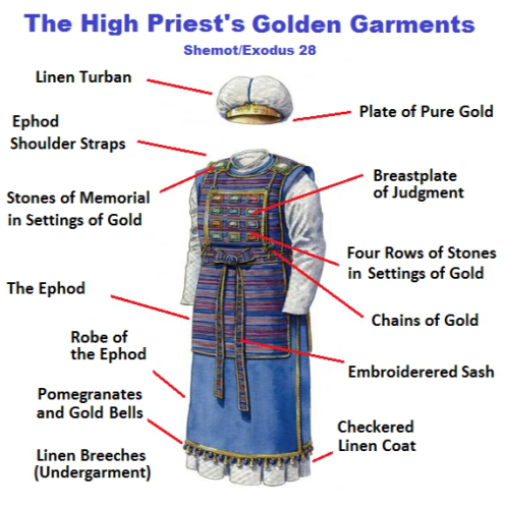
The High Priest was revered as much or more than any king or royalty of the nations around Israel. Consequently, these clothes carried the richness and beauty that surpassed the royal robes of the mightiest kings of the surrounding empires. The “Golden Garment” of the High Priest’s uniform was a two-layered set of clothing which included the four garments of the regular priests plus four additional articles of clothing that were added to enhance the ritual beauty and honor of the sacredness of the duties of the High Priest in his daily work of atonement for the children of Israel. The golden garments were worn all year in the rituals performed as the High Priest when he, in view of the people of Israel, enters the sanctuary interior in the morning and evening sacrifices.
The High Priest and Priests wore no shoes or sandals, meaning they would walk barefoot, which is the prerequisite for walking on holy ground (Exodus 3:5).
The first four articles of clothing were uniquely worn by the High Priest, and the last four garments were similar to those worn by the other Priests except the girdle, which was unique for the “Golden Garment”:
- Breastplate
- Ephod (Vest or Apron)
- Robe (Coat – Outer Garment)
- Plate (Diadem or Crown)
- Coat (Long Shirt – Inner Garment)
- Turban (Hat or Mitre)
- Girdle (Linen (1) Belt or sash)
- Undergarments (Short Pants)
And these are the garments which they shall make; a breastplate, and an ephod, and a robe, and a broidered coat, a mitre, and a girdle: and they shall make holy garments for Aaron thy brother, and his sons, that he may minister unto me in the priest's office. And they shall take gold, and blue, and purple, and scarlet, and fine linen. (Exodus 28:4,5)
And of the blue, and purple, and scarlet, they made cloths of service, to do service in the holy place, and made the holy garments for Aaron; as the LORD commanded Moses. (Exodus 39:1)
"And Aaron and his sons thou shalt bring unto the door of the tabernacle of the congregation, and shalt wash them with water. And thou shalt take the garments, and put upon Aaron the coat, and the robe of the ephod, and the ephod, and the breastplate, and gird him with the curious girdle of the ephod: And thou shalt put the mitre upon his head, and put the holy crown upon the mitre. Then shalt thou take the anointing oil, and pour it upon his head, and anoint him. And thou shalt bring his sons, and put coats upon them. And thou shalt gird them with girdles, Aaron and his sons, and put the bonnets on them: and the priest's office shall be theirs for a perpetual statute: and thou shalt consecrate Aaron and his sons. (Exodus 29:4-9)
And he put upon him the coat, and girded him with the girdle, and clothed him with the robe, and put the ephod upon him, and he girded him with the curious girdle of the ephod, and bound it unto him therewith. And he put the breastplate upon him: also he put in the breastplate the Urim and the Thummim. And he put the mitre upon his head; also upon the mitre, even upon his forefront, did he put the golden plate, the holy crown; as the LORD commanded Moses. And Moses took the anointing oil, and anointed the tabernacle and all that was therein, and sanctified them. And he sprinkled thereof upon the altar seven times, and anointed the altar and all his vessels, both the laver and his foot, to sanctify them. And he poured of the anointing oil upon Aaron's head, and anointed him, to sanctify him. And Moses brought Aaron's sons, and put coats upon them, and girded them with girdles, and put bonnets upon them; as the LORD commanded Moses. (Leviticus 8:7-13)
Spiritual Significance:
Yarn and Thread Colors – Five Colors which is the Biblical Number for Grace.
Gold (pure) (1) – Almighty God who is Holy. Divinely Righteous.
Blue – Heaven the abode of God. God’s divinity has come from Heaven. Jesus the Messiah! The color of Grace. The Gospel of John – Jesus the Son of God.
Red – Blood (1), the requirement for redemption that leads to righteousness. In Hebrew, “Dham” means blood and “Adham” (i.e., Adam) means red-blooded man. Jesus came from Heaven to become a red-blooded man. (1 Corinthians 15:45-47) The Gospel of Mark – Jesus the suffering servant.
Purple – God’s Royal Blood in the Son of Man (Red) that came from Heaven (Blue). Red and blue combined yield purple. The Gospel of Matthew – Jesus of royal lineage.
White – Righteousness and purity. That is, right standing or rather the “right to stand” before our Holy God. The Gospel of Luke – Jesus the Son of Man.
The Golden Garments of the High Priest revealed Jesus as God the Great High Priest in Heaven. When the High Priest put on these garments, he was putting on Christ! It was as if “The Word” (i.e., Jesus) offered the animal sacrifices to God the Father.
1. Breastplate
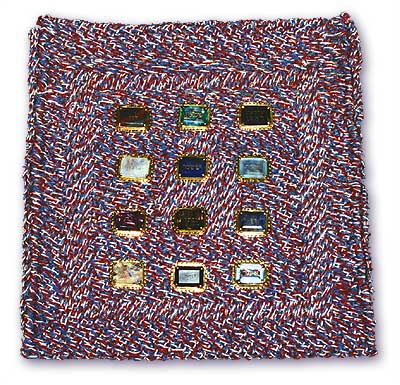
Over the ephod, the High Priest wore a breastplate which was a pouch about 22-cm (about 9 inches) square made of beautifully woven material. The Urim and Thummim were placed inside this pouch. The name Urim means “lights, ” while Thummim means “perfections.” On the front of the breastplate were fastened twelve precious stones in four rows of three. On each of these stones was engraved the name of one of the tribes of Israel. The breastplate was, in reality, a piece of elaborately finished cloth of the same material as the ephod. It was a strip twice as long as it was wide but folded back on itself to form a square bag into which the Urim and Thummim were placed. The breastplate was held in place by golden chains attached to the onyx shoulder clasps and blue lace ribbons, which attached the breastplate to the ephod. There must have been a small golden ring attached to each corner of the breastplate to which, in turn, the golden chains and ribbons were connected. The stones upon the breastplate represented the twelve tribes of Israel, and they were borne before the Lord continually as a memorial. Since the twelve stones were in one breastplate, they speak of the oneness of the people of God, while their position upon Aaron’s breast speaks of God’s affection for His people. The names on the breastplate were always close to Aaron’s heart, just as with Christ and His precious ones. The Bible instructs that each thread used in the High Priest’s breastplate and ephod must be 28 plies. Each thread is made from 6 threads, each of sky-blue, of purple, of crimson and of white twisted linen, and 4 threads of pure gold.
"And thou shalt make the breastplate of judgment with cunning work; after the work of the ephod thou shalt make it; of gold, of blue, and of purple, and of scarlet, and of fine twined linen, shalt thou make it. Foursquare it shall be being doubled; a span shall be the length thereof, and a span shall be the breadth thereof. And thou shalt set in it settings of stones, even four rows of stones: the first row shall be a sardius, a topaz, and a carbuncle: this shall be the first row. And the second row shall be an emerald, a sapphire, and a diamond. And the third row a ligure, an agate, and an amethyst. And the fourth row a beryl, and an onyx, and a jasper: they shall be set in gold in their inclosings. And the stones shall be with the names of the children of Israel, twelve, according to their names, like the engravings of a signet; every one with his name shall they be according to the twelve tribes. And thou shalt make upon the breastplate chains at the ends of wreathen work of pure gold. And thou shalt make upon the breastplate two rings of gold, and shalt put the two rings on the two ends of the breastplate. And thou shalt put the two wreathen chains of gold in the two rings which are on the ends of the breastplate. And the other two ends of the two wreathen chains thou shalt fasten in the two ouches, and put them on the shoulderpieces of the ephod before it. And thou shalt make two rings of gold, and thou shalt put them upon the two ends of the breastplate in the border thereof, which is in the side of the ephod inward. And two other rings of gold thou shalt make, and shalt put them on the two sides of the ephod underneath, toward the forepart thereof, over against the other coupling thereof, above the curious girdle of the ephod. And they shall bind the breastplate by the rings thereof unto the rings of the ephod with a lace of blue, that it may be above the curious girdle of the ephod, and that the breastplate be not loosed from the ephod. And Aaron shall bear the names of the children of Israel in the breastplate of judgment upon his heart, when he goeth in unto the holy place, for a memorial before the LORD continually. And thou shalt put in the breastplate of judgment the Urim and the Thummim; and they shall be upon Aaron's heart, when he goeth in before the LORD: and Aaron shall bear the judgment of the children of Israel upon his heart before the LORD continually. (Exodus 28:15-30)
And he made the breastplate of cunning work, like the work of the ephod; of gold, blue, and purple, and scarlet, and fine twined linen. It was foursquare; they made the breastplate double: a span was the length thereof, and a span the breadth thereof, being doubled. And they set in it four rows of stones: the first row was a sardius, a topaz, and a carbuncle: this was the first row. And the second row, an emerald, a sapphire, and a diamond. And the third row, a ligure, an agate, and an amethyst. And the fourth row, a beryl, an onyx, and a jasper: they were inclosed in ouches of gold in their inclosings. And the stones were according to the names of the children of Israel, twelve, according to their names, like the engravings of a signet, every one with his name, according to the twelve tribes. And they made upon the breastplate chains at the ends, of wreathen work of pure gold. And they made two ouches of gold, and two gold rings; and put the two rings in the two ends of the breastplate. And they put the two wreathen chains of gold in the two rings on the ends of the breastplate. And the two ends of the two wreathen chains they fastened in the two ouches, and put them on the shoulderpieces of the ephod, before it. And they made two rings of gold, and put them on the two ends of the breastplate, upon the border of it, which was on the side of the ephod inward. And they made two other golden rings, and put them on the two sides of the ephod underneath, toward the forepart of it, over against the other coupling thereof, above the curious girdle of the ephod. And they did bind the breastplate by his rings unto the rings of the ephod with a lace of blue, that it might be above the curious girdle of the ephod, and that the breastplate might not be loosed from the ephod; as the LORD commanded Moses. (Exodus 39:8-21)
And he shall stand before Eleazar the priest, who shall ask counsel for him after the judgment of Urim before the LORD: at his word shall they go out, and at his word they shall come in, both he, and all the children of Israel with him, even all the congregation." (Numbers 27:21)
And the Tirshatha said unto them, that they should not eat of the most holy things, till there stood up a priest with Urim and with Thummim. (Ezra 2:63)
And when Saul enquired of the LORD, the LORD answered him not, neither by dreams, nor by Urim, nor by prophets. (1 Samuel 28:6)
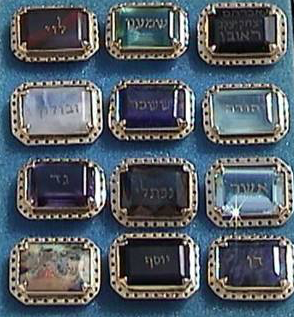
The only eye-witness account of the breastplate, outside of the Old Testament, is the written description of Josephus, who himself was a priest and served in his priestly duties in Herod’s Temple in Jerusalem. Josephus, Antiquities 3:7:1 – “Twelve stones were also on the breastplate, extraordinary in largeness and beauty; and they were an ornament not to be purchased by men, because of their immense value. These stones, however, stood in three rows, by four in a row, and were inserted into the breastplate itself, and they were set in (p)ouches of gold, that were themselves inserted in the breastplate and were so made that they might not fall out. Now the first three stones were a sardonyx, a topaz, and an emerald. The second row contained a carbuncle, jasper, and a sapphire. The first of the third row was a ligure, then an amethyst, and the third an agate being the ninth of the whole number. The first of the fourth row was a chrysolite, the next was an onyx, and then a beryl, which was the last of all. Now the names of all those sons of Jacob were engraved on these stones, whom we esteem the head of our tribes, each stone having the honor of a name, in the order according to which they were born. There was also a girdle sewed to the breastplate. which was of the forementioned colors, with gold intermixed which, when it had gone once round, was tied again upon the seam and hung down.”
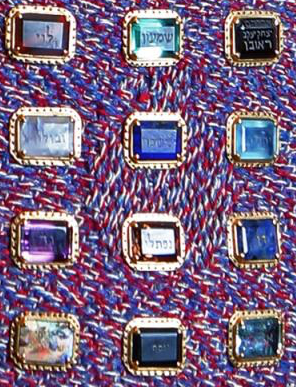
There are many opinions on what are the correct stones and order for the stones. Listed below are a few of them.
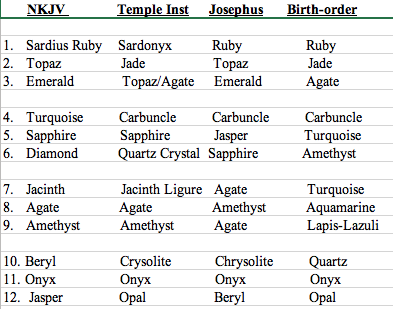

Best effort color determination of Breastplate Stone colors since some of the stones’ names have changed over time (Exodus 28:17-21. Exodus 39:10-14). Birth mother is indicated and the birth order (Genesis 29:31-35. Genesis 30:1-24. Genesis 35:16-19).
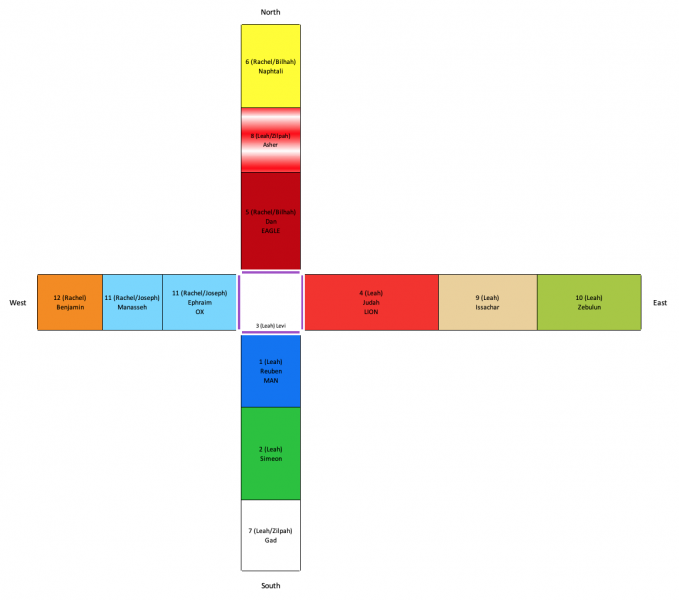
The figure above graphically depicts how Israel was instructed to camp (Numbers 2:1-34) with the width (East and West) or height (North and South) of each tribe corresponding to its population. This arrangement of the tribes forms a cross with its base to the East. There is some deviation from the Breastplate order as the tribe of Levi is in the middle of the camp around the tabernacle, and the tribe of Joseph is replaced with his two sons Ephraim and Manasseh, effectively giving the tribe of Joseph a double portion in the promised land.
Spiritual Significance:
The precious stones with the names represented that all of God’s Special Treasures (i.e., His people) are on His heart. (Deuteronomy 7:6. Titus 2:14) The names were not simply written on the stones but rather engraved, meaning they can never be removed. This means that we are eternally secure in Jesus. Hallelujah! Realize, precious stones are typically located deep within the earth. They have to be diligently searched for with great determination, excavated, washed, and finally cut and polished (1) by the master jeweler to release their true beauty. (Matthew 13:44) When God, who is light, looks upon us living stones in Christ, He sees reflected back His perfect light from the stones. This light reflects the righteousness of Jesus and does not expose our blemishes from sin but rather reflects the righteousness of Jesus who is a forever brilliant, beautiful, shining, priceless, precious, and secure person! He is not disappointed or angry at us living stones but rather well pleased since we are holy and perfect in Jesus Christ! (1 John 1:5. 1 Peter 2:4,5. Hebrews 12:23) This is because we are hidden in Christ, so the perfect light only reflects the perfect work of Jesus in removing our sins. That is, God the Father looks at Jesus to judge Christians. Again, He assesses us in the light of His unique Son, Jesus. What He is, is what we are in the sight of God. Consequently, it is NOT all about us but rather all about Jesus Christ, and we are hidden in Him! We are hidden in Jesus the PRECIOUS of God the Father (2 Peter 2:6), which makes us precious to Him! (1 Peter 2:9). These are the same precious stones in the Garden of God called Eden (Ezekiel 28:13), symbolizing when mankind was free from sin.
The preciousness of Jesus in the eyes of God the Father has been imputed to us even as His righteousness has been imputed to us. (1 Peter 2:9. 2 Corinthians 5:21) That is, God our Father looks upon us with all the favor with which He looks upon His own unique Son Jesus that He loves infinitely. Furthermore, the Lord clothes us with His own beauty, having imputed to us His sanctification. (1 Corinthians 1:30) The Father sees us in His Son, not apart from Him with the glorious radiance of the One that is Altogether Lovely (i.e., Totally Desirable) shines upon us. (Song of Songs 5:16) We have been brought by Jesus, our Great High Priest, to the place where we have entered into the presence of God the Father. It is a place of unlimited grace (i.e., unlimited favor). No demand made upon that grace can delete it. For all time and eternity, we are the objects of the Father’s supreme affection, the recipients of His unlimited mercies (i.e., unlimited ability to meet all our needs, wants, and desires). (Romans 5:1,2. Hebrews 4:16) (5)
The Breastplate was attached to the Ephod by two solid gold chains on each side that were braided and twisted for double strength, meaning we are securely attached to our Great High Priest. On each side, one chain represents that we will never be snatched from God our Father’s hand, and a second chain represents we will never be snatched from our God Jesus’ hand. (John 10:28,29) Nothing can separate us from the love of God in Christ Jesus our Lord (Romans 8:38,39)
The Breastplate was also attached to the Ephod by one piece of blue wool yarn on each lower side. When Jesus cried out “FINISHED” from the cross, He only said one word in Aramaic: “KŪLÁH: Finished or fulfilled! (John 19:30) It is the verb form of the word, “Complete.” This is the root word for “Tekhelet,” pronounced “te-KAY-let,” which was the blue robe worn by the high priest. That word literally means “blue.” Consequently, the blue thread is another picture of the God who came from Heaven, our Lord and Savior Jesus Christ, whose completed work is what holds us close to God our Father’s heart.
2. Ephod
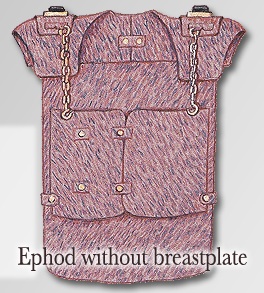
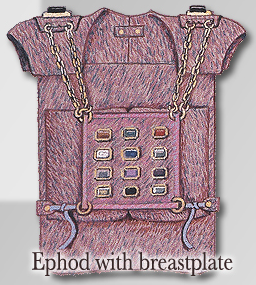
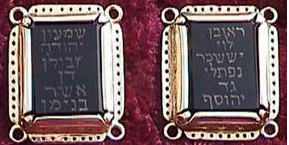
Pictured above: Memorial Stones with the names of the Twelve Tribes of Israel, which had the names of the sons of Israel (Jacob) according to their birth order and were placed on the shoulders of the ephod (Exodus 28:9-12. Exodus 39:6,7).
Spiritual Significance:
These stones represented that all the names of God’s Special Treasure (i.e., His people) and their needs are carried on His shoulders which represents being upheld by His strength. (Isaiah 9:6) They demonstrate that all believers, from the latest convert to the mature believer, are equally precious and complete in His sight. Also, the names were not simply written on the stones but rather engraved, meaning they can never be removed. This means that we are eternally secure in Jesus. Hallelujah!
Blue, purple, and scarlet wool yarn along with white linen thread and pure gold thread of the ephod.
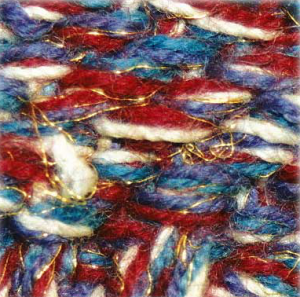
Pictured above: Blue, purple, and scarlet wool yarn along with white linen thread and pure gold thread.
The most important garment worn by the High Priest is the ephod. Its appearance can be likened to an apron; it was worn in back, on top of his other garments, and was fastened by a long belt in the front, opposite his heart. This belt was woven into the entire length of the ephod’s upper hem. There were also had two shoulder straps that were sewn onto the belt. These straps went behind, up, and slightly over the garment’s upper corners, over the priest’s shoulders. The settings for the two sardonyx stones (i.e., memorial or remembrance stones) were attached at the ends of these straps, on the shoulders. According to Josephus, the engraved onyx stones on the shoulders were designed so that the six eldest sons’ names were engraved on the stone on the right shoulder and those of the six youngest sons on the stone on the left shoulder. (3) The ephod covered the back of his body. It was long – it extended from just below his elbows, all the way to his heels. It was slightly wider than a man’s back since it was to cover his back and extend a little towards the front on both sides as well, covering a portion of his belly from either side. Gold was beaten, pressed, and hammered into paper-thin sheets, then cut into tiny strips. These were then rolled and hammered some more until each piece was the tiniest, finest pure gold thread.
"And they shall make the ephod of gold, of blue, and of purple, of scarlet, and fine twined linen, with cunning work. It shall have the two shoulderpieces thereof joined at the two edges thereof; and so it shall be joined together. And the curious girdle of the ephod, which is upon it, shall be of the same, according to the work thereof; even of gold, of blue, and purple, and scarlet, and fine twined linen. And thou shalt take two onyx stones, and grave on them the names of the children of Israel: Six of their names on one stone, and the other six names of the rest on the other stone, according to their birth. With the work of an engraver in stone, like the engravings of a signet, shalt thou engrave the two stones with the names of the children of Israel: thou shalt make them to be set in ouches of gold. And thou shalt put the two stones upon the shoulders of the ephod for stones of memorial unto the children of Israel: and Aaron shall bear their names before the LORD upon his two shoulders for a memorial. And thou shalt make ouches of gold; And two chains of pure gold at the ends; of wreathen work shalt thou make them, and fasten the wreathen chains to the ouches. (Exodus 28:6-14)
And he made the ephod of gold, blue, and purple, and scarlet, and fine twined linen. And they did beat the gold into thin plates, and cut it into wires, to work it in the blue, and in the purple, and in the scarlet, and in the fine linen, with cunning work. They made shoulderpieces for it, to couple it together: by the two edges was it coupled together. And the curious girdle of his ephod, that was upon it, was of the same, according to the work thereof; of gold, blue, and purple, and scarlet, and fine twined linen; as the LORD commanded Moses. And they wrought onyx stones inclosed in ouches of gold, graven, as signets are graven, with the names of the children of Israel. And he put them on the shoulders of the ephod, that they should be stones for a memorial to the children of Israel; as the LORD commanded Moses. (Exodus 39:2-7)
While the priestly garments were allowed to have a combination of wool and linen, those of the laity were not. Likely this had to do with the sacredness of the priesthood’s garments and what these materials and colors represented typologically.
Thou shalt not wear a garment of divers sorts, as of woollen and linen together. (Deuteronomy 22:11) (cf. Leviticus 19:19; Ezekiel 44:17–18)
Spiritual Significance:
The making of the gold thread provides a glimpse into what our Jesus endured for our sakes when He was beaten, pressed, hammered, cut, bruised, and battered for our redemption. He took a merciless beating so we would not have to take one! (Isaiah 53:5. 1 Peter 2:24)
“Blue” speaks of Jesus’ Divinity as Very God having come down from Heaven the abode of God. It is also the color of grace. Before He was born of Mary, Jesus was “All God” or rather “All Blue.” I believe God made the sky blue to reflect the glory of His Son!
Purple is the color of Royalty. Jesus is the King of Kings and Lord of Lords! Note It is always mentioned second.
Scarlet, or red, is the last color mentioned. In Hebrew, the word for red is “Adam” or “Edom.” Adam, one of the words for “man” and literally means “red-blooded man.” It is derived from the root word in Hebrew for blood: “Dam.” Red speaks of Jesus’ shed blood, The One Who became the second and last “Adam,” or “red or red-blooded man.”
White represents Jesus’ purity and righteousness which is the legal foundation for our redemption. Notice that there are five components: Gold, blue, purple, scarlet, and linen. That’s the number of GRACE! Jesus, the one full of Grace and Truth!
Note the story told by the colors and their order: Blue – Jesus who is God came from heaven, Red – Jesus was born of a red-blooded human virgin to become the Son of Man. Purple – the God-Man (Blue+Red=Purple) Jesus who is the Last Adam! No need for a third or more Adam as this one finished the work! That is, God became something He was not before. He used to be only “All God,” but now He is also “All man,” making Him the Perfect Man! That means today there is a real, live, beating human heart in Heaven representing you and me at the right hand of the Father. Jesus, our Great High Priest, has human emotions, human understanding, and human compassion. (Hebrews 2:17;4:15) He does not simply understand what we feel, He feels what we feel! When you and I accept Jesus as our personal Savior, we, the “red” of human birth, accept the “blue” of Christ’s divinity, and we become “purple,” too! We become like Jesus with the difference that we started out all red and He started out all blue (i.e., all God). Once you become purple, you can never become red again. That is, you cannot lose your salvation because the work of the Last Adam was greater than the work of the First Adam! (John 10:28,29).
3. Robe (Tekhelet)
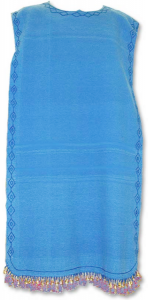
The Sky-Blue (the color of the sky at noon) robe or tekhelet (Hebrew) was a closed garment, seamlessly woven from one piece of fabric and slipped on over the head. It was worn over the coat; the coat was longer than the robe by one handbreadth, so it was visible underneath the robe at the bottom. The garment hung down in front and in the back, and its length extended all the way down to the priest’s feet. The neck’s opening was round, with a hem that was doubled over and closed by weaving-not by a needle. Note the neck of this garment was specifically fortified to prevent it from accidentally tearing. Remember, it was customary in Israel to tear their garments and put sackcloth and ashes on their heads upon the death of a relative (Genesis 37:33,34). The High Priest’s garment was holy and sacred; therefore, not to be torn even for a relative’s death. (Leviticus 21:10. Leviticus 10:1-7) Furthermore, he could not go near any dead person, including his father and mother (Leviticus 21:11). That is, his personal emotions cannot overrule his ministry to represent people to God. However, at Jesus’ Sanhedrin trial, the High Priest Caiaphas (the name means rock) tore his clothes even though this was forbidden. (Matthew 26:62-65)
Spiritual Significance:
The Hebrew word “tekhelet” literally means “blue,” with its root word meaning “complete” … Consequently, the blue robe represents that the finished work of grace completed by Jesus, our Great High Priest, will never end (i.e., not undone or torn). In Jesus’ statement, “It is finished,” we have a declaration of salvation that is both in a particular moment in time and eternity. Hallelujah! The robe is put on from above, meaning not self-appointed but rather office and authority God appointed (John 19:11).
The tearing by Caiaphas of the priestly garments represented the abolishment of the Levitical Priesthood and its replacement after the Melchizedek Priesthood order. (Psalms 110:4) That is, Jesus was to become the eternal High Priest, our Great High Priest. Hallelujah! (Hebrews 5:6,10; 6:20) Even as the Levites were priests of the Old Covenant, we believers are all priests and kings after the order of Melchizedek and ministers of the New Covenant. Melchizedek’s name comes from two Hebrew words: Melchi, meaning King, and Zedek, meaning Righteousness. He was also the King of Salem, which means peace. (Genesis 14:18,20. Hebrews 7:1-17) Therefore, He is the King of Righteousness and Peace and a giver of righteousness that leads to peace with God the Father. (Romans 5:1,2)
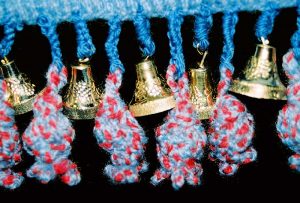
Decorative pomegranates made of sky-blue, purple, and crimson-dyed wool were attached to the robe’s lower hem. These pomegranates were actually hollow spheres of fabric in the shape of pomegranates. Some believe that the bells and pomegranates were interspersed alternatively, in between each other; however, others hold that the bells were placed inside the pomegranates (the author of this article believes the latter). The robe’s hem was woven over double to prevent it from ripping due to the weight of the pomegranates and bells. Again, no sewing was used, simply weaving. Its threads were 12 plies.
"And thou shalt make the robe of the ephod all of blue. And there shall be an hole in the top of it, in the midst thereof: it shall have a binding of woven work round about the hole of it, as it were the hole of an habergeon, that it be not rent. And beneath upon the hem of it thou shalt make pomegranates of blue, and of purple, and of scarlet, round about the hem thereof; and bells of gold between them round about: A golden bell and a pomegranate, a golden bell and a pomegranate, upon the hem of the robe round about. And it shall be upon Aaron to minister: and his sound shall be heard when he goeth in unto the holy place before the LORD, and when he cometh out, that he die not. (Exodus 28:31-35)
And he made the robe of the ephod of woven work, all of blue. And there was an hole in the midst of the robe, as the hole of an habergeon, with a band round about the hole, that it should not rend. And they made upon the hems of the robe pomegranates of blue, and purple, and scarlet, and twined linen. And they made bells of pure gold, and put the bells between the pomegranates upon the hem of the robe, round about between the pomegranates; A bell and a pomegranate, a bell and a pomegranate, round about the hem of the robe to minister in; as the LORD commanded Moses. (Exodus 39:22-26)
Spiritual Significance:
Pomegranates – a reminder that man’s (i.e., the First Adam’s) disobedience by partaking of the forbidden fruit (i.e., a pomegranate) from the Tree of the knowledge of good and evil resulted in spiritual death (i.e., separation from God), thus requiring God to come from Heaven as a man born of a virgin (i.e., Jesus the Last Adam) to shed His Royal blood to pay the price for our redemption. (1 Corinthians 15:45,47)
Golden Bells – ringing out the good news that Jesus the Last Adam has paid the price of our sin from eating the forbidden fruit! We can now approach God and see His face without dying (Exodus 28:35) and not just His backside like Moses under the law. We are now at peace with God because Jesus has born the full judgment of God’s wrath for us! (Exodus 33:20-23. Romans 5:1;10:15. Ephesians 2:13-18. 1 John 3:2)
4. Plate
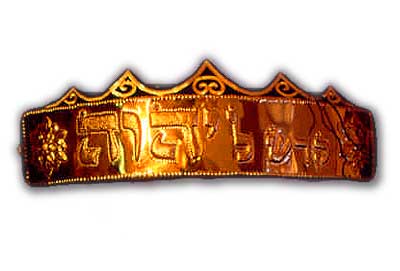
This diadem, crown, or headband was constructed with one piece of pure gold engraved with the simple message, “Holy to the Lord.” Unlike the crown worn by royalty on top of the head, this is worn across the forehead and extends from ear to ear. It was thin enough to arch across the forehead like a bow. Its width is approximately 4 cm (approximately 1.5 inches). It was worn at all times while the High Priest was within the Temple. The crown had three small holes: two on each end and one in the center located along the upper edge. Through these holes, threads dyed with Sky-Blue color were run, and the ends of these threads were connected in the back of the priest’s head. In this manner, the crown, itself a thin plate, was kept tied and in place on the High Priest’s forehead.
"And thou shalt make a plate of pure gold, and grave upon it, like the engravings of a signet, HOLINESS TO THE LORD. And thou shalt put it on a blue lace, that it may be upon the mitre; upon the forefront of the mitre it shall be. And it shall be upon Aaron's forehead, that Aaron may bear the iniquity of the holy things, which the children of Israel shall hallow in all their holy gifts; and it shall be always upon his forehead, that they may be accepted before the LORD. (Exodus 28:36-38)
And they made the plate of the holy crown of pure gold, and wrote upon it a writing, like to the engravings of a signet, HOLINESS TO THE LORD. And they tied unto it a lace of blue, to fasten it on high upon the mitre; as the LORD commanded Moses. (Exodus 39:30-31)
Spiritual Significance:
The High Priest is also a King of Israel! As long as he wore the crown his thoughts were considered pure.
5. Coat
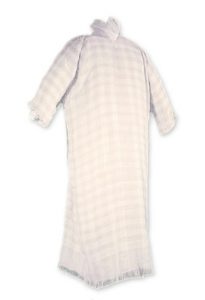
All the priests, including the high priest, wore a white linen coat or kethoneth (Hebrew), a long-sleeved ankle-length garment. The coat was first invented by God for Adam and Eve after they had sinned, and He made them from the skin of an animal which I believe was a ram. (Genesis 3:21) However, here the coat was made out of very fine linen. Each garment was individually made from the finest white flax linen in Israel. It was made by “fine weaving,” in which there was no sewing except to sew on the arm sleeves. This “skillful weave” was not the routine cross-weave pattern found in most linen garments made from Israel’s looms. Rather it was made into a weaving pattern of small boxes or cells, or diamond-shaped, giving it an appearance of a white on white honeycomb. Linen is a unique fabric that keeps the wearer cool in hot weather and warm when cold, which were efficient qualities for living in an arid climate with hot days and cold nights. The wearer of such linen made from breathable flax fibers would not sweat.
Jesus’ coat was made out of the finest linen and was completely seamless. It was this very expensive garment that the Roman soldiers gambled for at the foot of His cross. (John 19:23,24)
And thou shalt embroider the coat of fine linen... (Exodus 28:39 a)
And they made coats of fine linen of woven work for Aaron, and for his sons – (Exodus 39:27)
  And it shall come to pass, that when they enter in at the gates of the inner court, they shall be clothed with linen garments; and no wool shall come upon them, whiles they minister in the gates of the inner court, and within.
  They shall have linen bonnets upon their heads, and shall have linen breeches upon their loins; they shall not gird themselves with any thing that causeth sweat.  (Ezekiel 44:17-18)
Spiritual Significance:
White typifies righteousness and purity. Long sleeves were worn by privileged people, meaning they did not have to perform manual labor. That is, we have the righteousness of Jesus imputed to us based on His finished work and are now free from the impossible task of attempting to earn righteousness through our dead works (1). (Colossians 3:9,10. 2 Timothy 1:9. Titus 3:5. Ephesians 2:8,9. Romans 11:6) Hallelujah!
Sweat was part of the curse and represents human works, effort, reasoning, striving, worrying, fear, etc. (Genesis 3:19). God redeemed our sweat when Jesus’ great drops of sinless blood mixed with the great drops of the sweat of the second and last Adam, Jesus, in the second garden (Gethsemane). (Luke 22:44) That is, He redeemed us from sweat produced from human works, effort, striving, worrying, fear, etc., and gave us His rest and peace! (John 14:27) We are to rest in Jesus’ completed work seated with Him (i.e., resting) in the Heavenly realms. (Ephesians 2:4-6) Hallelujah! This does not mean we are to sit around and do nothing all day. (2 Thessalonians 3:10) But rather this means as we go through our daily lives, we are to rest in Jesus, not worrying about what we shall eat, drink, or wear, etc. (Matthew 6:25-34)
6. Mitre
Again, linen is a unique fabric that keeps the wearer cool in hot weather and warm when it is cold which were very practical qualities for living in an arid climate with hot days and cold nights. The wearer of such linen would not sweat.
...make the mitre of fine linen... (Exodus 28:39 b)
And a mitre of fine linen, and goodly bonnets of fine linen, and linen breeches of fine twined linen. (Exodus 39:28)
And thou shalt put it on a blue lace, that it may be upon the mitre; (Exodus 28:37)
And they tied unto it a lace of blue, to fasten it on high upon the mitre; as the LORD commanded Moses. (Exodus 39:31)
Spiritual Significance:
God desires His ministers to be even-tempered (i.e., cool-headed). The blue cord represents that Jesus’ mind is our mind (i.e., the mind of Christ). His thoughts are for us. God is not looking at my thoughts to judge me but rather the thoughts of the high priest. What Jesus is, we are in the sight of God. God, the Father, takes the holy and righteous thoughts of Jesus and imputes them to us. Again, what Jesus is – is what we are in the sight of God!
7. Girdle
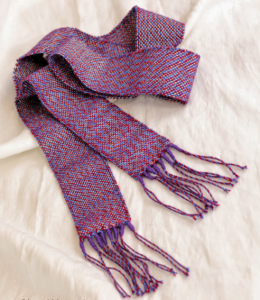
The ephod’s front and back were made to be as one garment by a girdle or sash, which was tied about the priest’s waist. This belt was made of a mixture of blue, purple, and scarlet wool yarn and white linen thread.
...make the girdle the work of needlework. (Exodus 28:39 c)
And a girdle of fine twined linen, and blue, and purple, and scarlet, of needlework; as the LORD commanded Moses. (Exodus 39:29)
8. Undergarments
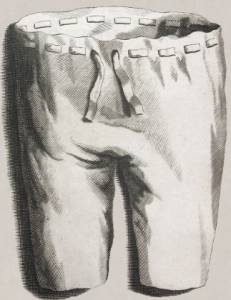
God invents boxer shorts! Again, linen is a unique fabric that keeps the wearer cool in hot weather and warm when cold, which were efficient qualities for living in an arid climate with hot days and cold nights. The wearer of such linen would not sweat. Note that God is concerned about covering our nakedness or private parts (Exodus 20:26. 1 Corinthians 12:20-24). Satan seeks to display them in a shameful, exploitative way leading to a sense of vulnerability that approximates a fear of evil (Genesis 3:7).
And thou shalt make them linen breeches to cover their nakedness; from the loins even unto the thighs they shall reach: And they shall be upon Aaron, and upon his sons, when they come in unto the tabernacle of the congregation, or when they come near unto the altar to minister in the holy place; that they bear not iniquity, and die: it shall be a statute for ever unto him and his seed after him. (Exodus 28:42,43)
Spiritual Significance:
God desires His ministers to have cool passions.
For this is the will of God, even your sanctification, that ye should abstain from fornication: That every one of you should know how to possess his vessel in sanctification and honour; Not in the lust of concupiscence, even as the Gentiles which know not God. (1 Thessalonians 4:3–5)
The High Priest’s Day of Atonement Uniform
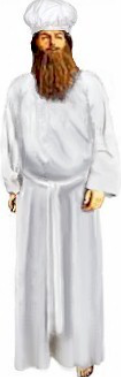
There was only one time of the year that the High Priest wore the white garments. That day was the highest and most holy day of the year, the Day of Atonement, a day also called the Day of Judgment. These garments are made from white flax, hence their designation “the white garments.” They must be woven, and each thread used must be six-ply – woven from six individual strands of fabric.
This uniform consisted of four “White Garments”:
- Coat (Long Shirt – Inner Garment)
- Turban (Hat or Mitre)
- Girdle (Linen Belt or Sash)
- Linen Leggings (Short Pants – Undergarments)
"Thus shall Aaron come into the holy place: with a young bullock for a sin offering, and a ram for a burnt offering. He shall put on the holy linen coat, and he shall have the linen breeches upon his flesh, and shall be girded with a linen girdle, and with the linen mitre shall he be attired: these are holy garments; therefore shall he wash his flesh in water, and so put them on. (Leviticus 16:3,4)
Spiritual Significance:
The White Garments revealed Jesus as the Son of Man, the Last Adam, who stepped down from Heaven to become a servant and shed His blood for the original sin of the First Adam and everyone’s subsequent sins.
1. Coat
The same as High Priest’s Coat previously described.
The High Priest had two coats that he wore on the Day of Atonement. One he wore in the morning and the other in the evening. After the Day of Atonement’s conclusion, he will never again wear the white garments he officiated on this day. They are hidden in the place where he removes them.
"And Aaron shall come into the tabernacle of the congregation, and shall put off the linen garments, which he put on when he went into the holy place, and shall leave them there. (Leviticus 16:23)
2. Turban
The same as High Priest’s Turbin previously described.
3. Girdle
This girdle was made of only white linen thread.
4. Linen Leggings
The same as the High Priest’s undergarments previously described.
The Priest’s Year-round Uniform
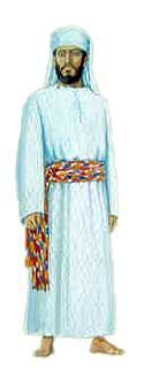
This uniform consisted of four garments:
- Coat (Long Shirt – Inner Garment)
- Turban (Hat or Mitre)
- Girdle (Linen Belt or Sash)
- Undergarments (Short Pants – Linen Leggings)
"And for Aaron's sons thou shalt make coats, and thou shalt make for them girdles, and bonnets shalt thou make for them, for glory and for beauty. And thou shalt put them upon Aaron thy brother, and his sons with him; and shalt anoint them, and consecrate them, and sanctify them, that they may minister unto me in the priest's office. (Exodus 28:40,41)
1. Coat
The same as the High Priest’s Coat previously described.
2. Turban
Similar material as the High Priests Turban previously described; however, it was donned by wrapping the head. It is made of linen and measures about ten centimeters wide and eight meters long (2.5 inches x 26 feet).
And Moses brought Aaron's sons, and put coats upon them, and girded them with girdles, and put bonnets upon them; as the LORD commanded Moses. (Leviticus 8:13)
3. Girdle
The same as the High Priest’s girdle previously described.
4. Linen Leggings
The same as the High Priest’s undergarments previously described.
Spiritual Significance:
But ye are a chosen generation, a royal priesthood, an holy nation, a peculiar people; that ye should shew forth the praises of him who hath called you out of darkness into his marvellous light. (1 Peter 2:9)
Credit: This section "The Preist's Apparel" was explained by Doulous Hall
All "NET" passages were converted into the words of God.
****



Ex. 37:1—"And Bezaleel made the ark of shittim wood: two cubits and a half was the length of it, and a cubit and a half the breadth of it, and a cubit and a half the height of it."
Let's now compare these accurate measurements above to Noah's Ark.
Its remains can be located:
39 26’26.90” N +44 14’05.20” E
(As viewed on google earth via satellite as of April 20, 2023, the right side of the remains of the silhouette of the ship has been airbrushed away. In times past this image could be clearly made out to be in the shape


of a large sea-worthy vessel dry-docked on the mountains of Ararat.)
Genesis 6:14-16 KJV
[14] Make thee an ark of gopher wood; rooms shalt thou make in the ark, and shalt pitch it within and without with pitch.
[15] And this is the fashion which thou shalt make it of: The length of the ark shall be three hundred cubits, the breadth of it fifty cubits, and the height of it thirty cubits.
[16] A window shalt thou make to the ark, and in a cubit shalt thou finish it above; and the door of the ark shalt thou set in the side thereof; with lower, second, and third stories shalt thou make it.
Gen. 6:15—"...The length of the ark shall be three hundred cubits,..."
Multiply a cubit in inches "21.6" by the known length of Noah's Ark of 300 cubits and that brings you to "6,480" inches.
6,480" / 12" = 540' exact.
Gen. 6:15—"...the breadth of it fifty cubits,..."
Multiply a cubit in inches "21.6" by the known breadth of Noah's Ark of 50 cubits and that brings you to "1,080" inches.
1,080" / 12" = 90' exact.
Gen. 6:15—"...the height of it thirty cubits."
Multiply a cubit in inches "21.6" by the known height of Noah's Ark of 30 cubits and that brings you to "648" inches.
648" / 12" = 54' exact
God gave Noah the exact dimensions of the ark and explicit directions in regard to its construction in every particular. Human wisdom could not have devised a structure of so great strength and durability. God was the designer, and Noah the master builder. It was constructed like the hull of a ship, that it might float upon the water, but in some respects it more nearly resembled a house. It was three stories high, with but one door, which was in the side. The light was admitted at the top, and the different apartments were so arranged that all were lighted. The material employed in the construction of the ark was the cypress, or gopher wood, which would be untouched by decay for hundreds of years. The building of this immense structure was a slow and laborious process. On account of the great size of the trees and the nature of the wood, much more labor was required then than now to prepare timber, even with the greater strength which men then possessed. All that man could do was done to render the work perfect, yet the ark could not of itself have withstood the storm which was to come upon the earth. God alone could preserve His servants upon the tempestuous waters.—PP:92.3


Comments
Post a Comment